
Listening skills are important skills for children to practice and improve, helping with understanding and communication. Listening skills can be improved in lots of different contexts, including summer and Christmas holidays, school and homeschool, days out and everyday life. Listening skills can also be improved through lots of different means, including playing games and listening to stories.
Here are some great ways to improve children’s listening skills:
- Play games that involve listening
- Read out stories and ask questions
- Ask children to fill in gaps in stories or songs
- Get children involved in sing-alongs and performances
- Read stories about listening
- Cook together
- Model good listening
Play games that involve listening
Playing games is a fun way of practicing and improving children’s listening skills. Listening skills can be developed by listening to the rules of the game when they are read out and recalled. They can also be developed by listening to what other players say when they make statements, ask questions, read out words on cards and engage in conversation.
There are many games that you can play to improve children’s listening skills:
‘Simon Says’ is a classic game which requires children to listen carefully to instructions and to only follow them if they hear ‘Simon says’.
‘I Went Shopping’ (alternative versions include ‘I Went to Market’ and ‘I Packed My Bag’) is a game in which children take turns to repeat a list of items that the other players say they have bought before adding another item to the list, with players dropping out of the game when they cannot recall the list correctly.
A treasure hunt with ‘hot’ and ‘cold’ clues provides children with a fun game in which they search for treasure and have to listen out to hear you say ‘cold’ when they are nowhere near the treasure and ‘hot’ when they are close to finding it.
A scavenger hunt for sounds is a game that can be done in everyday contexts or during day trips such as farm visits, in which children can be guided as they search for animal noises.
‘Guess the Sound’ is another listening-based game, in which children have to identify the sounds that they hear. Sounds can be made using objects that are out of sight or by playing audio clips.
Read out stories and ask questions
Reading out stories can provide further opportunity for children to improve their listening skills, especially when the stories and the way in which the stories are read are interesting and engaging. Additionally, asking questions can be useful for checking that children are engaging with the story and for encouraging them to continue to engage with it.
Ask children to fill in gaps in stories or songs
Asking children to fill in gaps in a familiar story or song is another exercise that can be used to improve listening skills. You can read out a story or sing a song, leaving gaps at certain points and prompting children to fill in the gaps with the words that are missing.
You can also use songs that incorporate call and response, in which the singer sings a line that is followed by a response, which can be given by the children.
Get children involved in sing-alongs and performances
There are lots of entertainment shows such as theatre performances that involve audience interaction, requiring children to listen to what is being said or asked. Sing-alongs also require listening skills, as children need to listen to the songs in order to be able to sing along to the right one.
Read stories about listening
Stories that are all about listening can enable children to hear and see practical scenarios in which listening can be helpful.
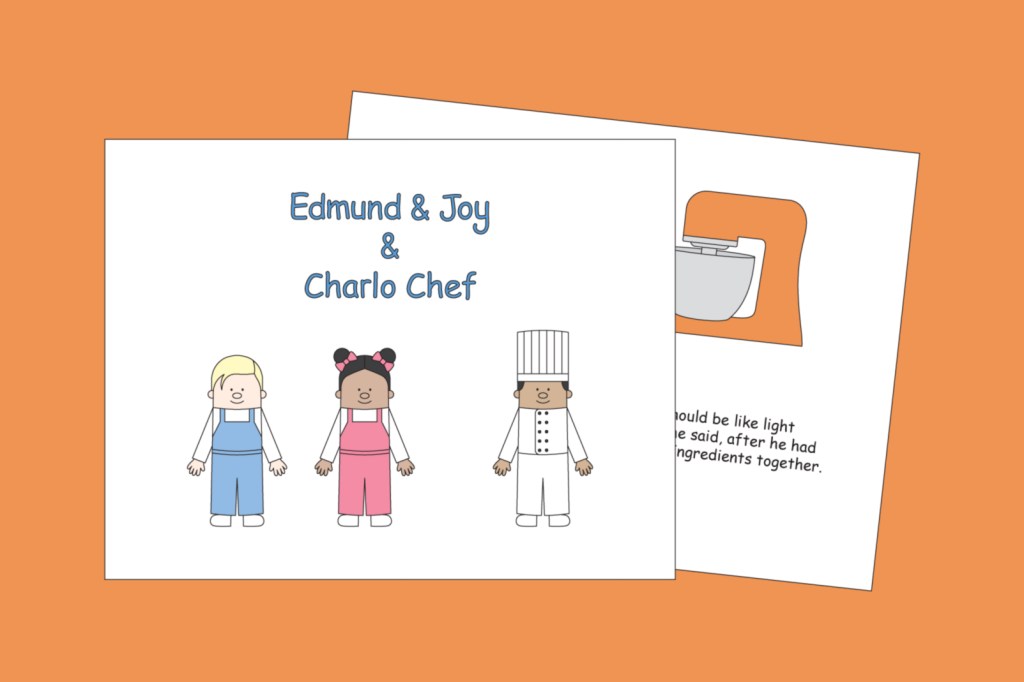
In our printable picture book ‘Edmund and Joy and Charlo Chef’, children can learn along with Edmund and Joy about the importance of listening to instructions (in this case listening to the instructions that Charlo Chef is giving in his cookery class) and how things can go wrong when people don’t listen!
For the US version of this book, click HERE. For the UK version of this book, click HERE.
Cook together
As demonstrated in our Edmund and Joy book, cooking can be a good way to learn to listen. Each instruction in a recipe can be read out for children to listen to as they cook with you. Supervising them along the way is helpful for letting them know when they are not listening as well as keeping them and everybody else safe!
Model good listening
Last but not least, listening well to children and to other people provides a great example for children to follow.
Disclaimer: Many Joyful Things makes no representations or warranties of any kind in relation to the information in this post.
 Many Joyful Things